What is a comparison rate and why does it matter? Learn how to read home loan comparison rates in Australia, spot hidden fees, and compare loans properly. Expert guide from Brokio.
When you see a home loan advertised at 6.09% p.a., that's the headline rate — the interest rate the lender charges on the loan. But it's not the full picture. Every home loan advertisement in Australia is legally required to show a comparison rate alongside the headline rate.
A comparison rate is a single percentage that includes both the interest rate and most fees and charges associated with the loan, expressed as a single annual rate. It's designed to help you compare apples with apples when looking at different loan products.
Before comparison rates were mandated, lenders could advertise very low interest rates while burying significant fees in the fine print. A loan advertised at 5.5% might have annual fees, monthly fees, establishment fees, and valuation fees that made the true cost much higher.
The Australian Securities and Investments Commission (ASIC) introduced comparison rate requirements under the National Consumer Credit Protection Act 2009 to give consumers a clearer picture of the total cost of a loan.
Consider two home loans:
At first glance, Loan B looks cheaper. But its comparison rate reveals significantly higher fees — making it more expensive overall. Loan A, despite the higher headline rate, is actually the better deal.
This is exactly the kind of trap that comparison rates help you avoid. And it's one of the first things we check at Brokio when comparing loan options for our clients.
Understanding how comparison rates are calculated helps you interpret them properly — and spot their limitations.
By law, comparison rates in Australia are calculated based on a standardised scenario:
The calculation takes the headline interest rate and then factors in known fees and charges to produce a single annual percentage rate that reflects the true annual cost of the loan under these standard conditions.
This is important to understand: the comparison rate is a useful starting point, but it's not the complete picture. More on this in Section 5.
Lenders spend millions on marketing, and the headline rate is their primary weapon. Here's how a low headline rate can disguise a more expensive loan.
Some lenders deliberately set a low interest rate to attract attention, then load the product with fees:
On a $600,000 loan, an annual fee of $395 is equivalent to roughly 0.066% on top of the rate. Not huge — but when lenders also add monthly fees, the gap widens.
Let's compare two actual loan structures on a $600,000 loan over 30 years:
Lender A — "Low Rate Special"
Lender B — "No Frills Basic"
Lender A looks cheaper on headline rate and even comparison rate. But here's the thing — the comparison rate is calculated on a $150,000 loan. On your actual $600,000 loan, the fixed annual fee has less impact per dollar borrowed, making Lender A genuinely better at higher loan amounts. But if you borrowed $200,000, Lender B might win.
Headline rates are marketing. Comparison rates are closer to reality. But your actual cost depends on your specific loan amount, term, and how you use the loan features. This is why working with a broker who runs the numbers on your scenario matters.
One of the most useful things about comparison rates is the gap between the headline rate and the comparison rate. This spread tells you a lot about the loan's fee structure.
Here's a scenario we see regularly at Brokio:
A client comes in with two options from their own research:
Option 1's low headline rate is eye-catching, but the 0.33% gap reveals substantial hidden fees. Option 2, despite the higher headline rate, is actually cheaper by comparison rate — and in total cost.
With the RBA potentially delivering further rate hikes in 2026 according to Westpac, and CBA already raising its 3-year fixed rate to 6.04%, comparing loans properly is more important than ever. Every basis point matters when rates are this high.
Home loan approvals surged 10.6% in January 2026, meaning more Australians are entering the market. Don't let the rush to buy lead you into a loan that costs more than it needs to. Take the time to compare — or let a broker do it for you.
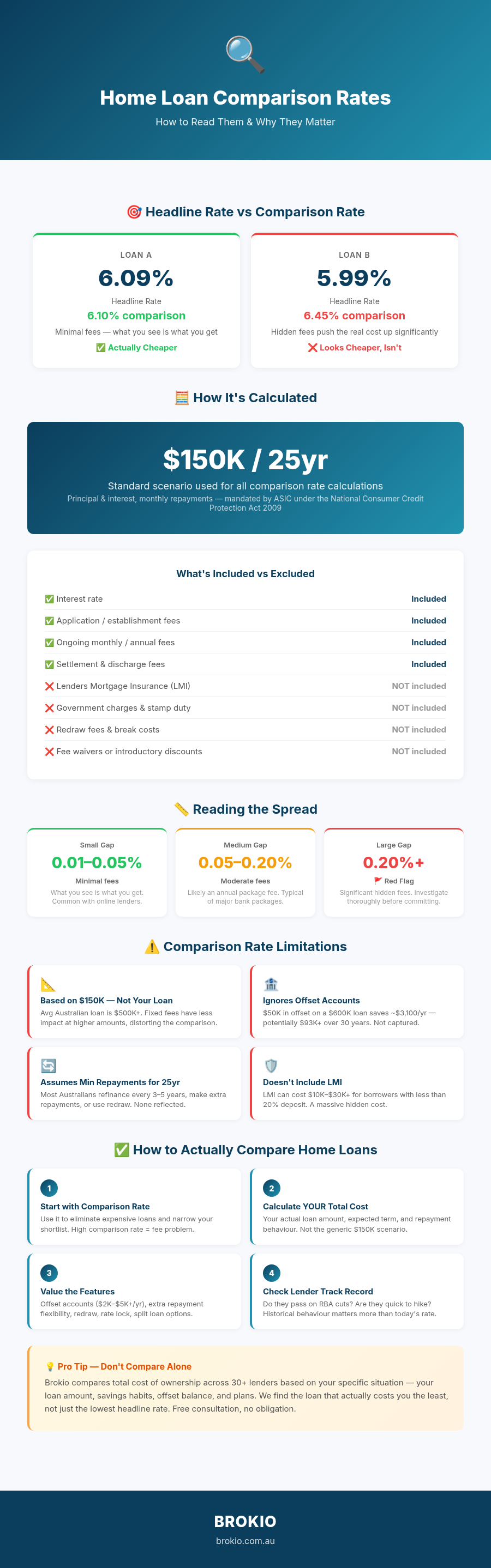
Comparison rates are a useful tool, but they're far from perfect. Here's what they miss — and why you shouldn't rely on them alone.
The standard calculation uses a $150,000 loan — but the average Australian home loan is now well over $500,000. Fixed fees (like annual package fees) have a much smaller impact per dollar on larger loans, meaning the comparison rate can overstate the impact of fees for higher loan amounts.
A $395 annual fee on a $150,000 loan adds ~0.26% to the cost. On a $700,000 loan? It's only ~0.056%. The comparison rate doesn't adjust for this.
An offset account is one of the most powerful loan features available. If you keep $50,000 in an offset account on a $600,000 loan at 6.2%, you effectively only pay interest on $550,000 — saving you $3,100 per year and potentially $93,000+ over 30 years.
But comparison rates don't factor this in. A loan with a higher comparison rate but a proper offset account could save you far more than a basic loan with a lower comparison rate and no offset.
The comparison rate assumes you'll make minimum monthly repayments for the full 25-year term. But most Australians:
None of these behaviours are captured in the comparison rate.
Lenders Mortgage Insurance can cost $10,000–$30,000+ for borrowers with less than 20% deposit. This is a massive upfront cost that isn't reflected in the comparison rate at all.
For fixed-rate loans, the comparison rate blends the fixed period with an assumed variable rate for the remainder of the term. This makes it harder to compare a 2-year fixed rate with a 5-year fixed rate, or either with a variable loan.
So if comparison rates have limitations, how should you actually compare home loans? Here's the approach we use at Brokio for every client.
Use the comparison rate to eliminate obviously expensive loans and narrow your shortlist. If a loan's comparison rate is significantly higher than competitors, there's a fee problem.
Take your actual loan amount, your expected term, and your planned repayment behaviour. Calculate the total cost including all fees for each loan on your shortlist. This is what we do at Brokio — we run the numbers on your specific situation, not a generic $150,000 scenario.
Consider what features matter to you and put a dollar value on them:
Some lenders attract customers with a low introductory rate, then fail to pass on RBA cuts (or are quick to pass on hikes). Check how a lender has behaved historically — not just their current rate.
At Brokio, we don't just compare rates. We compare total cost of ownership based on your specific situation:
We compare options across 30+ lenders and present you with a clear recommendation — not just the lowest rate, but the loan that will actually cost you the least over time.
Serving Williams Landing, Point Cook, Tarneit, Werribee and all of Melbourne, we're your local mortgage broker who takes the confusion out of home loans.
Book a free consultation with Brokio — we'll compare the real cost of your options and find you the best deal. Visit us at 601/87 Overton Road, Williams Landing VIC 3027.
Ready to explore tailored loan options? Contact Brokio today and let us guide you through your mortgage, car loan, personal loan, or investment property loan journey with confidence.


