Guarantor Home Loans Explained: How Your Parents Can Help You Buy a House

How guarantor home loans work in Australia. Learn how your parents can help you buy a house with a smaller deposit. Expert guide from Brokio, Williams Landing.

Published On
21/3/2026

Table of Contents

What Is a Guarantor Home Loan?

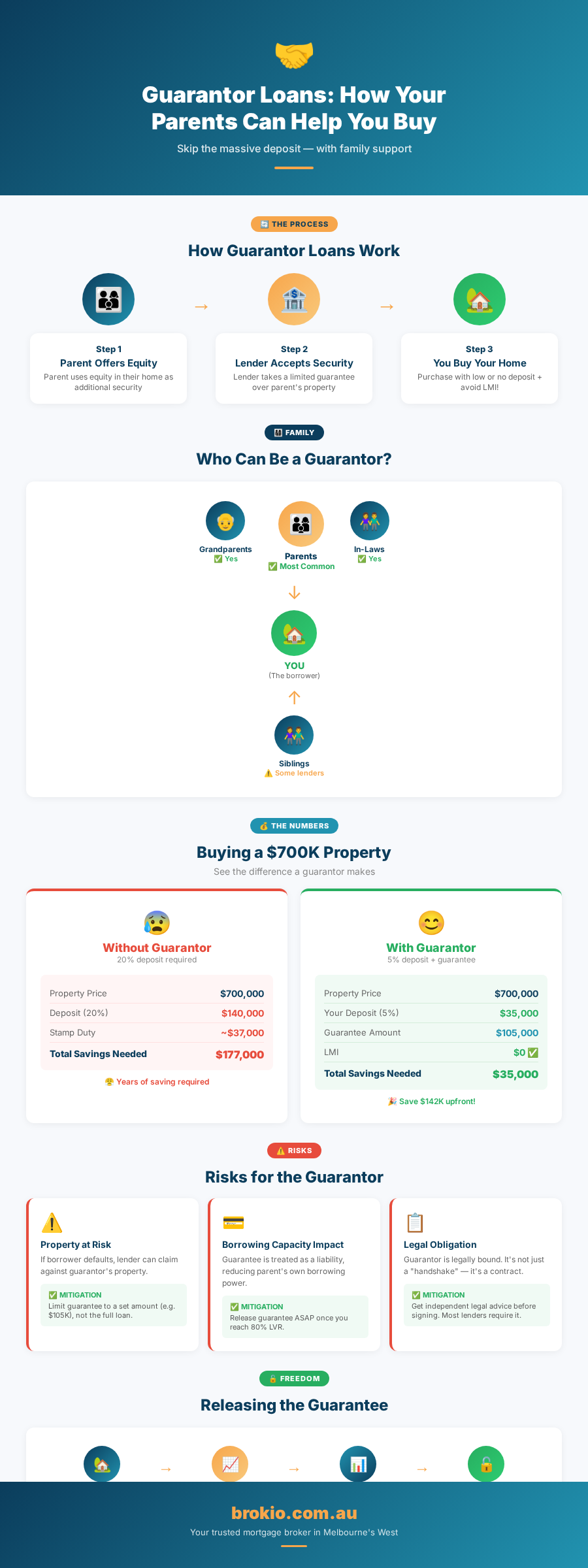
A guarantor home loan is a type of mortgage where a family member (usually a parent) offers their own property as additional security for your loan. This allows you to borrow more than you could on your own — often up to 100% of the purchase price plus costs — without paying Lenders Mortgage Insurance (LMI).

Think of it this way: instead of needing a full 20% deposit (which on a $700,000 property in Williams Landing would be $140,000), your parents' property equity acts as a "top-up" guarantee. You might only need 5% genuine savings ($35,000), with the guarantee covering the gap.

Why Guarantor Loans Exist

Australian property prices have outpaced wage growth for decades. In Melbourne's western suburbs, median house prices in areas like Point Cook ($700K+) and Williams Landing ($680K+) make it incredibly difficult for young buyers to save a 20% deposit while paying rent. By the time you've saved enough, prices have often moved further out of reach.

Guarantor loans bridge this gap. They allow younger Australians to enter the property market sooner, building equity through homeownership rather than paying someone else's mortgage through rent.

Key Benefits at a Glance

  • No LMI: Even with less than 20% deposit, the guarantee means the lender's risk is covered — so no LMI premium (saving $10,000-$30,000+)
  • Buy sooner: Enter the market years earlier than if you saved the full deposit alone
  • Better rates: Because the lender has additional security, you may qualify for more competitive interest rates
  • Temporary arrangement: The guarantee is designed to be removed once you've built sufficient equity — it's not forever

Guarantor loans are one of the most powerful tools available to first home buyers in Australia, and at Brokio, we help families in Williams Landing and Point Cook structure them properly every week.

How Guarantor Loans Work: The Two Types

Not all guarantor loans are the same. There are two main types, and understanding the difference is important for both you and your guarantor.

1. Security Guarantee (Most Common)

This is the most popular type of guarantor loan. Your parent (or family member) offers a portion of their property's equity as additional security for your loan. They don't give you money, and they don't go on your loan. Their property simply acts as extra collateral.

How it works:

  • You take out a home loan for 100% (or more) of the purchase price
  • The loan is split into two parts: Part A (up to 80% of the property value) is secured against your new home only
  • Part B (the remaining amount above 80%) is secured against both your new home and a portion of your guarantor's property
  • Your guarantor's liability is limited to the guarantee amount — not the full loan

2. Income Guarantee (Less Common)

With an income guarantee, your parent's income is used to supplement yours for serviceability purposes. This can help if you earn enough to make repayments but don't quite meet the lender's minimum income requirements on paper.

When this is useful:

  • You've recently changed jobs or are on probation
  • You're self-employed with fluctuating income
  • You're buying a more expensive property than your income alone supports

Income guarantees are riskier for the guarantor because they're essentially vouching that if you can't make repayments, they will. For this reason, most mortgage brokers (including us at Brokio) recommend security guarantees whenever possible — they're cleaner, simpler, and easier to release later.

The Loan Structure

Most lenders structure a guarantor loan as two separate loan splits. This is important because it means the guarantee portion can be released independently once you've built enough equity, without needing to refinance the entire loan. At Brokio, we always ensure the loan is structured this way from the start — it saves you time and money down the track.

Schedule your free consultation today to explore personalized loan options with our expert brokers.
Schedule a Meeting

Who Can Be a Guarantor & How Much Is Needed?

Lenders have specific rules about who can act as a guarantor. Here's what you need to know.

Who Can Be a Guarantor?

Most lenders accept the following family members as guarantors:

  • Parents — the most common guarantors by far
  • Grandparents — accepted by most lenders, though some have age limits
  • Siblings — accepted by some lenders, not all
  • In-laws — your partner's parents can guarantee for you as a couple
  • De facto partners' parents — increasingly accepted

Who typically can't be a guarantor:

  • Friends — very few lenders accept non-family guarantors
  • Extended family (aunts, uncles, cousins) — most lenders exclude them
  • Business partners — not accepted for residential loans

Guarantor Requirements

Your guarantor will need to meet certain criteria:

  • Sufficient equity: Their property must have enough equity to cover the guarantee amount (typically 20-25% of your purchase price)
  • Stable financial position: They can't be under financial stress themselves
  • No excessive debt: Their own mortgage and other debts will be assessed
  • Legal advice: Most lenders require the guarantor to obtain independent legal advice before signing — this protects everyone
  • Age considerations: Some lenders have maximum age limits (e.g., the guarantee can't extend beyond retirement age)

How Much Guarantee Is Typically Needed?

The guarantee amount is usually the difference between your deposit and 20% of the purchase price, plus any costs being financed (stamp duty, legal fees, etc.). For most first home buyers in Melbourne's west, this works out to roughly $80,000–$140,000 in guarantee — which sounds like a lot, but remember: this is just equity sitting in your parents' property. They don't hand over any cash.

Your parents' property doesn't need to be fully paid off either. As long as there's sufficient equity above their existing mortgage, they can still act as guarantor. For example, if your parents' home in Point Cook is worth $750,000 and they owe $300,000, they have $450,000 in equity — more than enough to provide a $120,000 guarantee.

Real Example: Buying a $700K Property in Williams Landing

Let's walk through a realistic example that many of our Brokio clients in Williams Landing can relate to.

The Situation

  • Buyer: Sarah, 28, earning $85,000/year as a marketing manager
  • Property: 3-bedroom house in Williams Landing — $700,000
  • Savings: $45,000 (about 6.4% of the purchase price)
  • Guarantor: Sarah's parents own a home in Point Cook valued at $780,000 with $250,000 remaining on their mortgage ($530,000 equity)

Without a Guarantor

If Sarah tried to buy without a guarantor:

  • Deposit needed for no LMI: $140,000 (20%) — she's $95,000 short
  • With 5% deposit ($35,000): She'd pay approximately $18,000–$25,000 in LMI
  • Total cash needed: $35,000 deposit + $25,000 LMI + ~$25,000 stamp duty and costs = $85,000+
  • She doesn't have enough, and even if she did, the LMI is dead money

With a Guarantor

  • Loan Part A: $560,000 (80% LVR) — secured against the Williams Landing property only
  • Loan Part B: $140,000 (remaining 20%) — secured against both the Williams Landing property and a portion of her parents' Point Cook home
  • Guarantee amount: ~$120,000 (covering the gap between Sarah's deposit and 20%)
  • LMI: $0 — completely avoided because the total security covers the full loan
  • Sarah's cash needed: $45,000 for deposit + ~$20,000 for stamp duty and costs = $65,000

The Savings

By using a guarantor, Sarah:

  • Saves $18,000–$25,000 in LMI
  • Buys 3-4 years sooner than if she'd continued saving for 20%
  • Starts building equity immediately instead of paying rent
  • Can release the guarantee in approximately 2-4 years once she's built 20% equity through repayments and property growth

This is a scenario we see regularly at Brokio. The numbers change, but the outcome is the same — guarantor loans help buyers get into the market sooner, without wasting money on LMI.
Guarantor Home Loans Explained - Brokio
Schedule your free consultation today to explore personalized loan options with our expert brokers.
Schedule a Meeting

Risks for the Guarantor & How to Minimise Them

Let's be honest about the risks. Being a guarantor is a generous act, and it does carry some exposure. Here's what your parents (or family member) need to understand.

Risk 1: You Default on the Loan

If you can't make your mortgage repayments and the lender needs to recover their money, the guarantor's property could be at risk. In the worst-case scenario, the lender could force the sale of the guarantor's property to recover the guaranteed amount.

Mitigation:

  • The guarantee is limited to a specific amount (not the whole loan) — so your parents' exposure is capped
  • The lender would sell your property first. The guarantor's property is only touched if the sale of yours doesn't cover the guaranteed portion
  • Income protection insurance and life insurance can protect against job loss or illness
  • Building a buffer of 3-6 months' repayments gives you breathing room

Risk 2: It Affects the Guarantor's Borrowing Power

While the guarantee is active, lenders treat it as a contingent liability for your guarantor. This means if your parents want to refinance their own loan, buy another property, or access equity, the guarantee may reduce their borrowing capacity.

Mitigation:

  • Release the guarantee as soon as possible (typically 2-4 years)
  • Some lenders are more flexible than others in how they assess guarantees — Brokio can help your parents find the right lender if they need to refinance while the guarantee is active

Risk 3: Relationship Strain

Money and family can be a tricky combination. If financial pressures arise, the guarantee can create tension between family members.

Mitigation:

  • Be completely transparent about your financial situation — before and after buying
  • Set clear expectations about when the guarantee will be released
  • Both parties should get independent legal and financial advice before proceeding
  • Put everything in writing

Independent Legal Advice Is Mandatory

Most lenders require the guarantor to obtain independent legal advice before the guarantee is finalised. This is actually a great safeguard — it ensures your parents fully understand their obligations and rights. The cost is typically $200–$500 and is money well spent for peace of mind.

How to Release the Guarantee & How Brokio Can Help

The good news is that a guarantor arrangement is temporary. Here's how and when you can release it.

When Can You Release the Guarantee?

You can apply to release the guarantee once your loan-to-value ratio (LVR) drops to 80% or below — meaning you owe 80% or less of your property's current value. This happens through a combination of:

  • Making repayments: Each monthly payment reduces your loan balance
  • Property value growth: If your Williams Landing property increases in value (very likely over 2-4 years), your LVR drops even if your loan balance hasn't changed much
  • Extra repayments: Making additional payments accelerates the process

The Release Process

  1. Get a property valuation: The lender will order a valuation of your property to determine its current market value
  2. Apply for guarantee release: If your LVR is at or below 80%, you submit a formal request to release the guarantee
  3. Lender approves: The lender removes the security over your guarantor's property
  4. Your guarantor is free: Their property is no longer tied to your loan in any way

Typical Timeline

In Melbourne's western suburbs, where property values have been growing steadily, most of our clients at Brokio release their guarantor within 2-4 years. Some manage it even sooner if they make extra repayments or if property values grow strongly.

What If No Guarantor Is Available?

If you don't have a family member who can act as guarantor, you still have options:

  • First Home Guarantee: Buy with 5% deposit, no LMI (government-backed)
  • Help to Buy: Federal scheme offering 2% deposit with government equity share
  • LMI: Pay the premium (can be capitalised into the loan) and buy with 5-10% deposit
  • Shared equity: Some state programs allow shared ownership arrangements

How Brokio Structures Guarantor Loans

At Brokio, guarantor loans are one of our specialities. Based in Williams Landing and serving Point Cook, Tarneit, and all of Melbourne's west, we:

  • Assess your full financial picture and your guarantor's position
  • Compare guarantor loan products from 30+ lenders to find the best rate and structure
  • Ensure the loan is split correctly for easy future guarantee release
  • Guide both you and your guarantor through the process step by step
  • Proactively monitor your LVR and let you know when it's time to release the guarantee

Ready to explore guarantor home loans? Book a free consultation with Brokio. Bring your parents along — we'll explain everything clearly so everyone feels comfortable. Call us or visit our office at 601/87 Overton Road, Williams Landing VIC 3027.

Get in touch today

Ready to explore tailored loan options? Contact Brokio today and let us guide you through your mortgage, car loan, personal loan, or investment property loan journey with confidence.

Check - Elements Webflow Library - BRIX Templates

Thank you

Thanks for reaching out. We will get back to you soon.
Oops! Something went wrong while submitting the form.

Want to reach out directly?

Mortgage Broker in Point CookMortgage Broker in Hoppers Crossing