Debt Consolidation Loans: Should You Combine Your Debts in 2026?

Wondering if a debt consolidation loan is right for you in 2026? Learn how to combine debts, reduce repayments, and simplify your finances with Brokio's expert guidance.

Published On
22/3/2026

Table of Contents

What Is a Debt Consolidation Loan?

If you've ever found yourself juggling multiple repayments across credit cards, personal loans, car finance, and maybe even a buy now pay later account or two, you're not alone. Thousands of Australians in suburbs like Williams Landing and Point Cook are in exactly the same position — and it's exhausting. That's where a debt consolidation loan comes in.

The Basic Concept

A debt consolidation loan is, at its core, a single new loan that's used to pay off multiple existing debts. Instead of making four, five, or six separate repayments each month — each with its own interest rate, due date, and minimum payment — you roll everything into one loan with one repayment. Simple.

Think of it like tidying up a messy desk. All those scattered papers (your debts) get organised into one neat folder (your consolidation loan). The debts don't disappear — you still owe the money — but managing them becomes dramatically easier.

How It Works in Practice

Here's the typical process when you combine debts in Australia:

  • Add up your total debts — credit cards, personal loans, car loans, afterpay balances, store cards, and any other outstanding obligations.
  • Apply for a consolidation loan — this could be a personal loan, a line of credit, or even a top-up on your existing home loan (more on that in Section 6).
  • Use the new loan to pay off existing debts — your broker or lender will often handle this directly, paying out each creditor on your behalf.
  • Make one regular repayment — typically at a lower overall interest rate than what you were paying across multiple accounts.

Why Australians Are Turning to Consolidation in 2026

With interest rates having shifted significantly over recent years and the cost of living continuing to bite, many households across Melbourne's western suburbs are feeling the squeeze. Credit card interest rates in Australia commonly sit between 18% and 22%, and personal loan rates can range from 7% to 15% depending on the lender and your credit profile.

When you're paying minimum repayments across several high-interest accounts, a huge chunk of your money goes straight to interest — not to actually reducing the debt. A well-structured debt consolidation loan can change that equation entirely, potentially saving you thousands of dollars over the life of the loan.

The key word there is well-structured. Not every consolidation deal is a good one, and that's exactly why working with a qualified mortgage broker like Brokio matters. We'll walk through the details in the sections ahead so you can make an informed decision about whether consolidation is the right move for your situation in 2026.

Secured vs Unsecured Consolidation: Which Type Is Right for You?

Not all debt consolidation loans are created equal. One of the most important decisions you'll need to make is whether to go with a secured or unsecured consolidation loan. The difference can have a massive impact on your interest rate, your repayment amount, and — critically — your level of risk.

What Is a Secured Debt Consolidation Loan?

A secured consolidation loan is backed by an asset, most commonly your home. Because the lender has the security of your property, they're willing to offer significantly lower interest rates. This is the same principle behind why home loan rates are so much lower than credit card rates — the lender's risk is reduced.

Common forms of secured consolidation include:

  • Home loan top-up — increasing your existing mortgage to cover your other debts (we cover this in detail in Section 6).
  • Refinancing with debt consolidation — switching to a new home loan that includes enough extra to pay out your other debts.
  • Secured personal loan — using your car or another asset as security for a personal loan that consolidates your debts.

The major advantage? Interest rates on secured loans can be as low as 5.5% to 7% in the current market, compared to the 18–22% you might be paying on credit cards. That's a significant saving.

What Is an Unsecured Debt Consolidation Loan?

An unsecured consolidation loan doesn't require any asset as security. You borrow based purely on your income, credit history, and ability to repay. These are typically personal loans offered by banks, credit unions, and online lenders.

Unsecured loans are a good option if:

  • You don't own property or don't have enough equity in your home.
  • Your total debt is relatively modest (say, under $20,000–$30,000).
  • You want a shorter loan term — typically 2 to 7 years — to force yourself into paying it off faster.
  • You'd prefer not to put your home on the line.

The trade-off is that unsecured loan rates are higher — generally between 7% and 15% depending on the lender and your credit score. Still far better than credit card rates, but not as cheap as a mortgage-backed option.

Which One Should You Choose?

There's no one-size-fits-all answer. It depends on your circumstances:

  • If you own a home with equity and your debts are substantial, a secured option (like a mortgage top-up) usually offers the best savings.
  • If you're a renter or first home buyer, an unsecured personal loan could still save you a fortune compared to high-interest revolving debt.
  • If your debts are small (under $10,000), the costs of setting up a secured loan might outweigh the interest savings.

This is exactly the kind of analysis a Brokio broker does during a free consultation — comparing your options side by side so you choose the path that genuinely works for your finances, not just the one that sounds good on paper.

Schedule your free consultation today to explore personalized loan options with our expert brokers.
Schedule a Meeting

When Does Debt Consolidation Actually Make Sense?

Debt consolidation sounds great in theory, but it's not a magic fix for every situation. Before you rush into combining your debts, it's worth understanding when it genuinely makes sense — and when it might actually make things worse.

The Ideal Scenario for Consolidation

A debt consolidation loan tends to work best when the following conditions apply:

  • You have multiple high-interest debts. If you're carrying balances on two or more credit cards at 20%+ interest, plus a personal loan at 12%, consolidation into a lower-rate product can save you serious money.
  • You're making minimum repayments and barely denting the principal. This is the classic debt trap — you pay $200 a month on a credit card and $180 of it goes to interest. Consolidation breaks that cycle.
  • Your total debt is manageable relative to your income. Consolidation restructures debt; it doesn't reduce it. You still need the income to service the new loan.
  • You're committed to not racking up new debt. This is the big one. If you consolidate $40,000 in credit card debt into your mortgage and then start spending on the cards again, you'll end up worse off than where you started.

When Consolidation Might NOT Be the Right Move

There are genuine scenarios where consolidation could hurt you:

  • You're already close to paying off your debts. If you've only got a few months of repayments left on a personal loan, the fees and setup costs of a new consolidation loan might not be worth it.
  • Your spending habits haven't changed. Consolidation treats the symptom, not the cause. Without addressing the underlying spending patterns, you risk doubling your debt load.
  • You'd be extending the loan term dramatically. Rolling a $15,000 credit card debt into a 30-year mortgage means you could end up paying far more in total interest, even at a lower rate. The maths needs to be checked carefully.
  • You don't qualify for a meaningfully lower rate. If your credit score has taken a hit and the best rate you can get isn't much lower than what you're currently paying, the benefits shrink quickly.

The Sweet Spot for Williams Landing and Point Cook Residents

Many of our clients in Williams Landing and Point Cook are young families or professionals who bought their homes in the last five to ten years. They've built up some equity but have also accumulated lifestyle debts — credit cards used during renovations, car loans, afterpay balances, and the occasional personal loan for a holiday or unexpected expense.

For these households, consolidation often makes excellent sense because:

  • They have usable equity in a property that's grown in value.
  • Their debts are spread across three or more products with varying rates and terms.
  • They want to simplify their finances and free up cash flow for family expenses or further investment.

If this sounds like your situation, it's worth having a no-obligation chat with the team at Brokio. We'll look at your full financial picture and tell you honestly whether consolidation is the right call — or if there's a better strategy for your circumstances.

Pros and Cons of Combining Your Debts

Every financial decision has trade-offs, and combining your debts in Australia is no exception. Let's lay out the honest pros and cons so you can weigh them up properly before making a move.

The Pros of Debt Consolidation

  • Lower overall interest rate. This is the headline benefit. Moving from multiple debts at 15–22% interest down to a single loan at 5.5–10% can save you thousands of dollars per year in interest charges alone. For many families in Melbourne's west, this is the difference between treading water and actually getting ahead.
  • One simple repayment. Instead of tracking four or five different due dates, amounts, and accounts, you make one payment. This reduces the chance of missed payments (which hurt your credit score) and makes budgeting dramatically easier.
  • Reduced monthly repayment amount. By securing a lower rate — and potentially a longer term — your total monthly outgoing can drop significantly. This frees up cash flow for everyday living expenses, savings, or investing.
  • Psychological relief. Don't underestimate this one. The mental load of managing multiple debts is real. Simplifying to one loan can reduce financial stress and give you a clearer path to becoming debt-free.
  • Potential credit score improvement. Paying off multiple credit card balances and closing those accounts can actually improve your credit score over time, as it reduces your total available credit and shows responsible debt management.

The Cons of Debt Consolidation

  • You might pay more in total interest over the life of the loan. This is the most common trap. If you roll $30,000 in short-term debt into a 30-year mortgage, the lower rate is offset by the vastly longer repayment period. You must structure additional repayments to avoid this — a good broker will help you set this up.
  • Fees and costs. Depending on the consolidation method, you may face application fees, valuation fees, discharge fees on existing loans, and potentially lenders mortgage insurance (LMI) if your loan-to-value ratio exceeds 80%. These costs need to be factored into the equation.
  • Risk of re-accumulating debt. Once your credit cards are paid off, it's tempting to start using them again. Without discipline, you can end up with the consolidation loan plus new credit card balances — a much worse position than before.
  • Secured loans put your home at risk. If you consolidate unsecured debts (like credit cards) into your mortgage, those debts are now secured against your property. If you default, your home is on the line. That's a serious consideration.
  • Not everyone qualifies. Lenders still assess your ability to service the consolidated loan. If your income has dropped or your credit history is poor, you may not get approved — or you may only qualify for higher-rate products that don't offer much benefit.

The Bottom Line

Debt consolidation is a powerful tool when used correctly, but it's not a set-and-forget solution. The key is structuring it properly — choosing the right product, setting the right loan term, making additional repayments where possible, and closing old credit accounts to avoid temptation.

That's exactly what we help clients do at Brokio. Our brokers in Williams Landing and Point Cook don't just find you a loan — we build a repayment strategy that actually gets you debt-free. Book a free consultation to see how the numbers stack up for your specific situation.
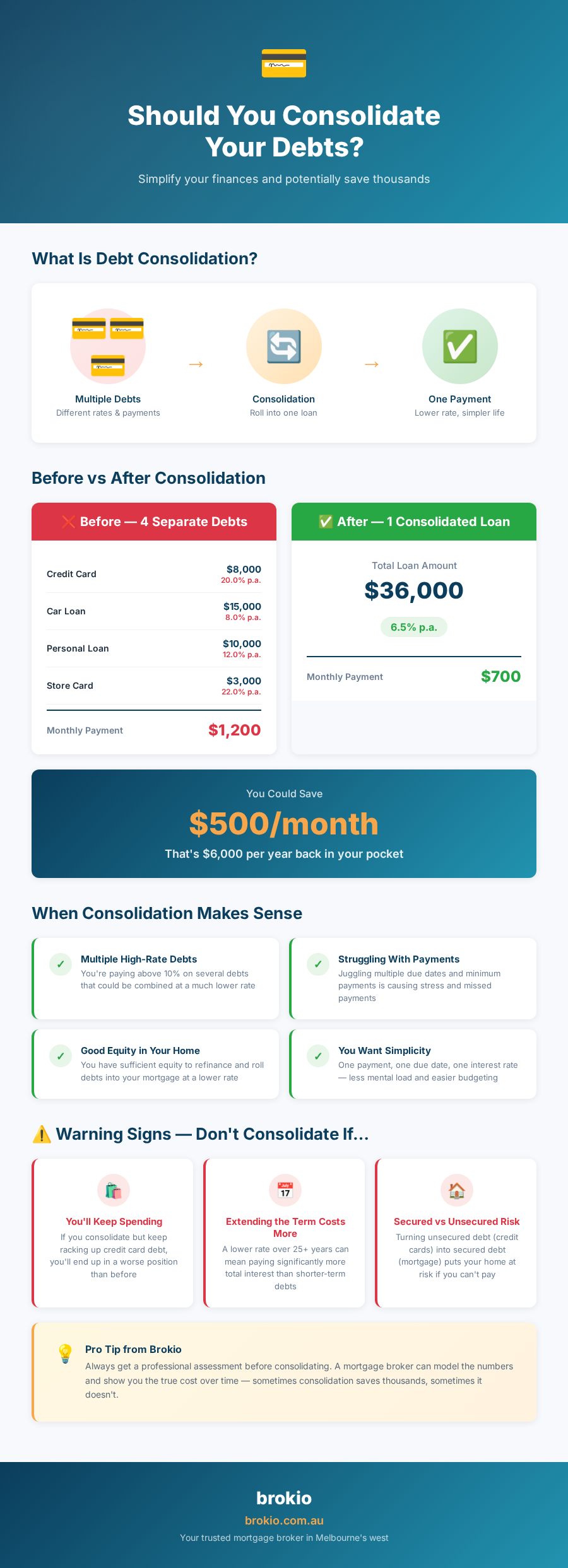
Debt Consolidation Loans Guide - Infographic by Brokio
Schedule your free consultation today to explore personalized loan options with our expert brokers.
Schedule a Meeting

Real Example: Before and After Debt Consolidation

Numbers talk. Let's walk through a realistic example of how debt consolidation could work for a typical household in Point Cook or Williams Landing — the kind of scenario we see regularly at Brokio.

Meet Sarah and James: Before Consolidation

Sarah and James are a couple in their mid-thirties living in Williams Landing. They own their home (valued at $720,000) with a mortgage balance of $480,000. Over the past few years, they've accumulated the following debts alongside their mortgage:

  • Credit Card 1: $12,000 balance at 21.99% interest — minimum repayment $360/month
  • Credit Card 2: $8,500 balance at 19.49% interest — minimum repayment $255/month
  • Personal Loan: $15,000 at 12.5% interest — repayment $420/month (3 years remaining)
  • Car Loan: $18,000 at 8.9% interest — repayment $380/month (4 years remaining)

Total non-mortgage debt: $53,500

Total monthly repayments (excluding mortgage): $1,415/month

On top of their mortgage repayment of approximately $3,100/month, Sarah and James are paying a combined $4,515 per month in loan repayments. That's a massive chunk of their household income, and a significant portion of those payments is going straight to interest rather than reducing the actual debt.

After Consolidation: The Mortgage Top-Up Strategy

Working with Brokio, Sarah and James refinance their home loan and increase it by $53,500 to pay out all four debts. Their new mortgage balance is $533,500.

Here's what changes:

  • New mortgage rate: 5.89% (competitive rate sourced by Brokio across our panel of 40+ lenders)
  • New mortgage repayment: approximately $3,420/month (principal and interest over the remaining loan term)
  • Additional voluntary repayment: $500/month directed to the mortgage to accelerate the consolidated debt portion

New total monthly repayment: $3,920/month

The Savings Breakdown

  • Monthly saving: $4,515 − $3,920 = $595 per month back in their pocket
  • Annual saving: approximately $7,140
  • Interest saving over 5 years: estimated $28,000+ compared to continuing with their existing repayment structure

But here's the crucial part that makes this strategy work long-term: Brokio set up Sarah and James's loan with an offset account and structured the additional $500/month repayment specifically to target the consolidated portion. This means the $53,500 is projected to be paid off in approximately 7 years, not stretched over the full 30-year mortgage term.

The Result

Sarah and James went from managing five separate loan accounts to just one mortgage repayment. They freed up nearly $600 per month in cash flow, saved tens of thousands in interest, and have a clear timeline to be completely debt-free (beyond their original mortgage).

This is a simplified illustrative example. Actual rates, fees, and savings depend on individual circumstances, creditworthiness, and lender policies at the time of application. Want to see what your numbers look like? Book a free consultation with Brokio and we'll run the figures for your specific situation — no obligation, no pressure.

How Brokio Structures Debt Consolidation for Williams Landing & Point Cook Clients

If you've read this far, you're probably wondering: "Okay, this sounds promising — but how does it actually work with Brokio?" Great question. Here's exactly how we approach debt consolidation for our clients across Williams Landing, Point Cook, and Melbourne's western suburbs.

Step 1: Free Financial Health Check

Everything starts with a no-obligation consultation. We sit down (in person at our Williams Landing office or via video call — whatever suits you) and map out your complete financial picture:

  • All existing debts — balances, interest rates, minimum repayments, and remaining terms
  • Your income and household expenses
  • Your property value and current mortgage details (if applicable)
  • Your credit score and credit history
  • Your goals — is it about reducing monthly payments, getting debt-free faster, or both?

This isn't a sales pitch. It's an honest assessment. If consolidation isn't right for you, we'll tell you — and suggest what is.

Step 2: Strategy Selection

Based on your situation, we'll recommend the best consolidation pathway. For homeowners in the Williams Landing and Point Cook area, the most common strategies include:

  • Mortgage top-up: Increasing your existing home loan to absorb other debts. Best when you have sufficient equity and your current lender offers competitive rates.
  • Full refinance with consolidation: Switching to a new lender who offers a better rate, and rolling your other debts into the new mortgage at the same time. This is often the most powerful option — you improve your home loan rate and consolidate debts simultaneously.
  • Unsecured personal loan: For renters or homeowners who prefer to keep debts separate from their mortgage. We have access to a panel of personal loan providers and can find competitive rates based on your profile.

Step 3: Lender Comparison and Application

As mortgage brokers, we have access to 40+ lenders — from the big four banks to specialist lenders and credit unions. We compare options across our entire panel to find the product that genuinely offers the best outcome for your situation. This includes factoring in:

  • Interest rates (fixed, variable, or split)
  • Fees — application fees, ongoing fees, discharge fees from existing lenders
  • Loan features — offset accounts, redraw facilities, extra repayment flexibility
  • Approval likelihood based on your specific financial profile

We handle the application paperwork, liaise with the lenders, and manage the process from start to settlement.

Step 4: Repayment Strategy and Credit Score Protection

This is where Brokio goes beyond just finding a loan. We help you set up a structured repayment plan that ensures you're not just shuffling debt around but actively paying it down. This includes:

  • Setting up additional repayments targeted at the consolidated debt portion
  • Advising on whether to close old credit accounts (which can positively impact your credit score by reducing available credit)
  • Discussing the short-term credit score impact — yes, a new loan application creates a credit enquiry, and closing accounts can temporarily affect your score. But when managed properly, consolidation typically improves your credit position within 6–12 months
  • Ongoing check-ins to make sure the strategy is tracking as planned

Why Local Matters

We're based right here in Melbourne's west. We understand the property market in Williams Landing and Point Cook, we know the equity positions of local homeowners, and we understand the financial pressures facing families in these growing suburbs. That local knowledge means better advice, tailored to your reality — not generic recommendations from a call centre interstate.

Ready to take control of your debts in 2026? Contact Brokio today for a free, no-obligation debt consolidation consultation. Call us, visit our website at brokio.com.au, or drop into our Williams Landing office. Let's crunch the numbers together and find out if consolidation is the right move for you.

Get in touch today

Ready to explore tailored loan options? Contact Brokio today and let us guide you through your mortgage, car loan, personal loan, or investment property loan journey with confidence.

Check - Elements Webflow Library - BRIX Templates

Thank you

Thanks for reaching out. We will get back to you soon.
Oops! Something went wrong while submitting the form.

Want to reach out directly?

Mortgage Broker in Point CookMortgage Broker in Hoppers Crossing