Business Loans for Small Business Owners in Melbourne: Your 2026 Guide

Complete guide to business loans for Melbourne small business owners in 2026. Compare loan types, interest rates, eligibility and application tips. Expert advice from Brokio.

Published On
19/4/2026

Table of Contents

Business Loan Landscape in Australia: 2026 Overview

If you run a small business in Melbourne — whether you're a tradie in Point Cook, a café owner in Werribee, or a professional services firm in Williams Landing — there's a good chance you'll need external finance at some point. And in 2026, the lending landscape looks quite different from a few years ago.

The RBA cash rate sits at 4.10% as of March 2026, following a 0.25% increase. This has pushed business lending rates higher across the board, but it's also made lenders more competitive as they fight for quality borrowers. The result? More options than ever — but bigger rate spreads between the best and worst deals.

The Big Picture

Australia has over 2.5 million small businesses, and access to finance remains one of the biggest challenges for SME owners. The good news is that lending has evolved significantly. You're no longer limited to walking into your local CBA branch and hoping for the best. Today's market includes:

  • Big 4 banks (CBA, ANZ, NAB, Westpac) — still the largest SME lenders, offering secured business loans from around 7.5% p.a.
  • Tier 2 and regional banks — often more flexible on eligibility, rates from 8-15% p.a.
  • Fintech lenders (Prospa, OnDeck, Moula, Lumi) — fast approval, unsecured options, but higher rates from 12-28% p.a.
  • Equipment and asset finance specialists — self-securing loans against the asset, rates from 6-14% p.a.
  • Government-backed programs — including the SME Guarantee Scheme for businesses that don't have traditional security

Why the Right Loan Structure Matters

Here's what many business owners get wrong: they focus on getting any loan approved rather than getting the right loan. A business overdraft when you need a term loan, or an unsecured fintech loan when you could qualify for a much cheaper secured facility — these mistakes can cost tens of thousands in unnecessary interest.

That's where a broker comes in. At Brokio, we don't just find you a business loan — we match the right product to your specific situation, saving you money and headaches. And unlike going direct to a bank, we compare options across 30+ lenders in one go.

Types of Business Loans Available to Melbourne SMEs

There's no single "business loan" — there are multiple products designed for different needs. Here's a breakdown of the main types available to Melbourne small businesses in 2026.

1. Business Term Loan

The most straightforward option. You borrow a lump sum and repay it over a fixed period (typically 1-7 years) with regular repayments.

  • Best for: Expansion, fitouts, buying an existing business, large one-off purchases
  • Typical amounts: $20,000 – $5 million+
  • Rates (2026): 7.5% – 18% p.a. depending on security and lender
  • Security: Property or business assets (secured) or none (unsecured — higher rate)

2. Business Line of Credit / Overdraft

A revolving credit facility attached to your business account. You only pay interest on the amount you've drawn, not the full limit.

  • Best for: Managing cash flow gaps, seasonal fluctuations, bridging between invoices
  • Typical limits: $10,000 – $500,000
  • Rates (2026): 8% – 18% p.a. variable
  • Key benefit: Flexibility — draw and repay as needed without reapplying

3. Equipment / Asset Finance

Finance specifically for purchasing business equipment — vehicles, machinery, technology, medical equipment, tools. The asset itself acts as security.

  • Best for: Tradies, manufacturers, transport operators, healthcare practices
  • Typical amounts: $5,000 – $2 million+
  • Rates (2026): 6% – 14% p.a.
  • Structures: Chattel mortgage, finance lease, hire purchase, or rental

4. Invoice Finance (Debtor Finance)

Unlock cash tied up in unpaid invoices. The lender advances 80-90% of the invoice value, then collects from your customer.

  • Best for: B2B businesses with 30-90 day payment terms (construction, wholesale, professional services)
  • Fees: Typically 1.5% – 4.5% per invoice
  • Key benefit: Turns receivables into immediate cash without traditional debt

5. Merchant Cash Advance

An advance based on your future card sales. Repayments are a percentage of daily card transactions.

  • Best for: Retail and hospitality businesses with strong card turnover
  • Cost: Expensive — effectively 25-50%+ annualised
  • Use only as: A short-term bridging solution, not ongoing finance

6. Government-Backed SME Guarantee Scheme

The Australian Government's SME Guarantee Scheme allows lenders to offer unsecured loans to small businesses with a partial government guarantee. This means businesses without property security can still access term loans up to $5 million at better rates than purely unsecured products.

Choosing between these products is one of the most important financial decisions you'll make for your business. The wrong structure doesn't just cost more — it can strain cash flow at the worst possible time.

Schedule your free consultation today to explore personalized loan options with our expert brokers.
Schedule a Meeting

Business Loan Interest Rates in 2026: What to Expect

Interest rates on business loans vary dramatically depending on the lender type, security offered, your time in business, and your financial profile. Here's the current rate landscape as of April 2026.

Rate Overview by Lender Type

Lender Type Typical Rate (p.a.) Security Approval Speed
Big 4 Banks (secured) 7.5% – 12.5% Property/assets 2–6 weeks
Big 4 Banks (unsecured) 11% – 18% None/limited 1–2 weeks
Equipment Finance 6% – 14% Asset (self-securing) 1–5 days
Fintech (unsecured) 12% – 28% None Same day – 48hrs
Merchant Cash Advance 25% – 50%+ None Same day

What Determines Your Rate?

Two businesses applying for the same loan amount from the same lender can get rates 4-6 percentage points apart. The key factors are:

  • Security: Offering property security can cut your rate by 3-8% compared to unsecured
  • Time in business: Lenders strongly prefer 2+ years of trading history
  • Revenue and profitability: Strong, consistent turnover signals lower risk
  • Credit history: Both personal and business credit scores matter
  • Industry: Some industries are considered higher risk (hospitality, construction) and attract higher rates
  • Loan-to-value ratio (LVR): Borrowing less relative to your security = better rate

Fixed vs Variable Rates

With the RBA at 4.10% and market expectations of potential rate changes ahead, the fixed-vs-variable question is top of mind for business owners:

  • Variable: Moves with the market. More flexibility (often no break costs). Good if you think rates may fall or want to repay early.
  • Fixed (1-5 years): Certainty of repayments. Typically 0.5-1.5% premium over variable. Good for budgeting and predictability.

Pro tip: Don't just look at the headline rate. Factor in establishment fees ($0-$800), monthly account fees ($0-$30/month), and early repayment penalties. The total cost of the loan is what matters, not just the interest rate.

Eligibility: What Lenders Look for in Small Business Borrowers

Getting approved for a business loan in 2026 requires more than just a good idea. Here's what lenders actually assess — and the minimum requirements you'll need to meet.

Minimum Requirements (Most Lenders)

  • ABN registration: Active ABN, usually for at least 6-12 months (banks prefer 2+ years)
  • GST registration: Required by most lenders as proof of genuine business activity
  • Minimum turnover: Typically $75,000-$200,000+ per year depending on the lender and loan amount
  • Clean credit history: No defaults, bankruptcies, or court judgments. Some fintech lenders are more flexible on minor blemishes.
  • Australian residency: Must be an Australian citizen or permanent resident

Documentation You'll Need

The level of documentation varies by lender type. Banks require the most; fintechs the least.

For Bank Loans (Full Doc)

  • Last 2 years of business financial statements (profit & loss, balance sheet)
  • Last 2 years of business and personal tax returns
  • ATO Notice of Assessments
  • 6-12 months of business bank statements
  • BAS statements (last 4 quarters minimum)
  • Business plan (for larger loans or startups)
  • Details of existing debts and liabilities
  • Security details (property valuations if offering real estate)

For Fintech / Low-Doc Loans

  • 6-12 months of business bank statements (some accept read-only bank feed access)
  • BAS statements (last 2-4 quarters)
  • Proof of identity and ABN
  • Self-declaration of financial position

What Gets Applications Rejected?

The most common reasons small business loan applications fail in 2026:

  1. Insufficient trading history — especially for bank loans. Businesses under 2 years old face significantly higher rejection rates.
  2. ATO debt — outstanding tax obligations are a major red flag. Lenders check the ATO portal directly.
  3. Inconsistent revenue — large month-to-month swings without explanation make lenders nervous.
  4. Too much existing debt — if your business is already heavily leveraged, approval is unlikely.
  5. Poor personal credit — for small businesses (especially sole traders and partnerships), your personal credit score is heavily weighted.

The broker advantage: A good broker knows which lenders suit your specific profile. At Brokio, we pre-assess your application before submitting, so we only approach lenders where you have a genuine chance of approval. This protects your credit file from unnecessary enquiries and saves weeks of back-and-forth.
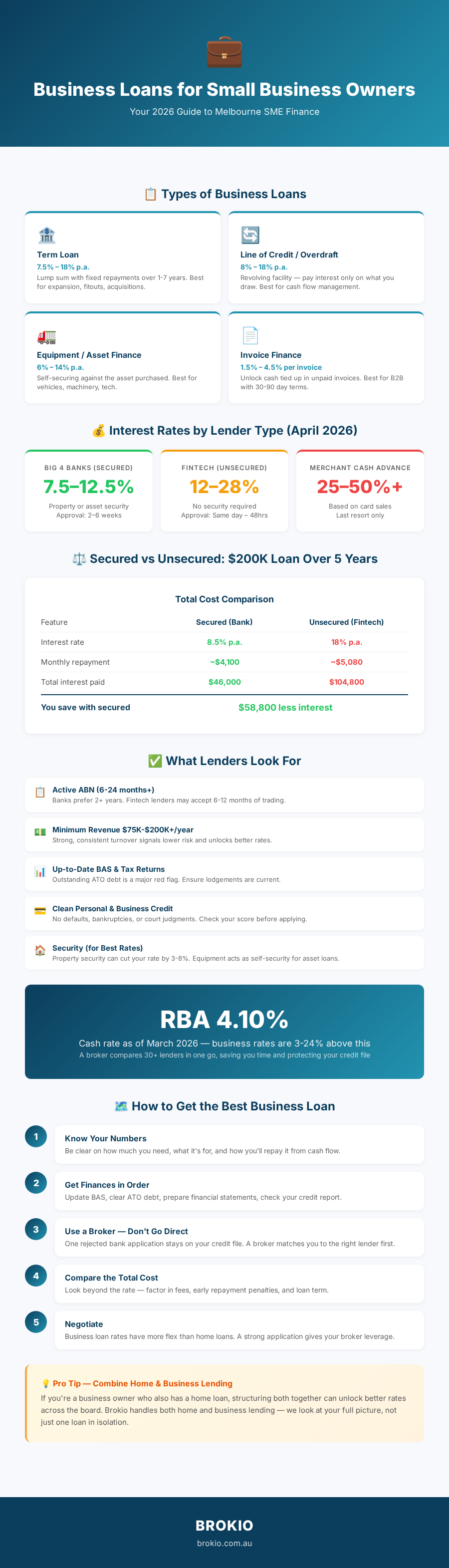
Business Loans for Small Business Owners in Melbourne - Infographic by Brokio
Schedule your free consultation today to explore personalized loan options with our expert brokers.
Schedule a Meeting

Secured vs Unsecured Business Loans: Which Is Right for You?

This is one of the biggest decisions you'll face when borrowing for your business. Both options have clear advantages and trade-offs.

Secured Business Loans

You offer an asset (usually property, but sometimes equipment or other business assets) as security for the loan. If you default, the lender can sell the asset to recover their money.

Pros

  • Much lower interest rates: 7.5% – 12.5% p.a. from major banks vs 12% – 28% unsecured
  • Higher borrowing amounts: Banks will lend larger sums against quality security
  • Longer loan terms: Up to 15-25 years for property-secured business loans
  • Better repayment flexibility: More options for interest-only periods or redraw

Cons

  • Asset at risk: Your home or investment property is on the line
  • Slower approval: Property valuations and legal work take 2-6 weeks
  • Setup costs: Valuation fees ($300-$600), legal fees, and potentially mortgage registration

Unsecured Business Loans

No asset is required as security. The lender assesses your business's cash flow, revenue, and creditworthiness.

Pros

  • No assets at risk: Your property and personal assets are protected
  • Fast approval: Some fintech lenders approve in hours, not weeks
  • Less paperwork: Streamlined applications, often via bank statement analysis
  • Good for newer businesses: Some lenders accept businesses trading for just 6-12 months

Cons

  • Higher interest rates: 12% – 28% p.a. is typical; significantly more expensive
  • Lower borrowing limits: Usually capped at $250,000-$500,000
  • Shorter terms: Typically 6 months to 3 years, meaning higher repayments
  • Personal guarantees: Directors usually still provide personal guarantees, even without property security

Real Cost Comparison

Let's compare a $200,000 business loan over 5 years:

Feature Secured (Bank) Unsecured (Fintech)
Interest rate 8.5% p.a. 18% p.a.
Monthly repayment ~$4,100 ~$5,080
Total interest paid $46,000 $104,800
Difference Secured saves you ~$58,800 in interest

That's nearly $60,000 in savings — a significant sum for any small business. Of course, if you don't have property to offer or need funds urgently, unsecured can still be the right choice. The key is understanding the true cost before you commit.

How to Apply for a Business Loan & How Brokio Can Help

Getting the best business loan isn't just about comparing rates — it's about presenting your business in the best possible light and approaching the right lender. Here's a step-by-step guide.

Step 1: Know What You Need (and Why)

Before approaching any lender, be clear on:

  • How much you need to borrow — be specific, not vague
  • What the funds are for — lenders want a clear purpose (expansion, equipment, working capital, stock)
  • Your repayment capacity — can your business comfortably service the loan from existing cash flow?
  • What security you can offer — residential property, commercial property, equipment, or none

Step 2: Get Your Finances in Order

The #1 reason applications stall is incomplete or messy financials. Before applying:

  • Ensure your BAS lodgements are up to date
  • Clear any ATO debt or set up a payment plan
  • Have your accountant prepare current financial statements
  • Review your personal credit report (free via Equifax or illion)
  • Organise 6-12 months of business bank statements

Step 3: Choose the Right Lender

This is where most business owners waste time. Going direct to one bank means you only see one option. And if you get rejected, that enquiry stays on your credit file.

A broker compares options across dozens of lenders — banks, non-banks, equipment specialists, and government-backed programs — and matches you to the best fit based on your specific circumstances.

Step 4: Apply and Negotiate

Once you've identified the right lender and product:

  1. Submit a complete application with all supporting documents
  2. Respond promptly to any lender queries or conditions
  3. Review the loan contract carefully — check for hidden fees, early repayment penalties, and ongoing conditions
  4. Negotiate — business loan rates often have more room for movement than residential mortgages

How Brokio Helps Melbourne Small Businesses

At Brokio, business lending is a growing part of what we do for the Melbourne western suburbs community. Based in Williams Landing, we work with small business owners across Point Cook, Tarneit, Werribee, Hoppers Crossing and beyond. Here's how we help:

  • Free assessment: We review your situation and tell you exactly what's achievable before you apply anywhere
  • Lender matching: We compare business loan products from banks, fintechs, and specialist lenders to find the best rate and structure for your needs
  • Application management: We handle the paperwork, chase lenders, and keep the process moving so you can focus on running your business
  • Ongoing support: As your business grows, we help you refinance, restructure, or access additional funding
  • Combined approach: If you're a business owner looking at both a home loan and business finance, we can structure both together for the best overall outcome

Ready to explore business loan options? Book a free consultation with Brokio. We'll review your financials, identify the best lender match, and guide you through the entire process. Call us or visit 601/87 Overton Road, Williams Landing VIC 3027.

Get in touch today

Ready to explore tailored loan options? Contact Brokio today and let us guide you through your mortgage, car loan, personal loan, or investment property loan journey with confidence.

Check - Elements Webflow Library - BRIX Templates

Thank you

Thanks for reaching out. We will get back to you soon.
Oops! Something went wrong while submitting the form.

Want to reach out directly?

Mortgage Broker in Point CookMortgage Broker in Hoppers Crossing